
Murray Fredericks: The Salt Lake
A Museum of Australian Photography (MAPh) touring exhibition
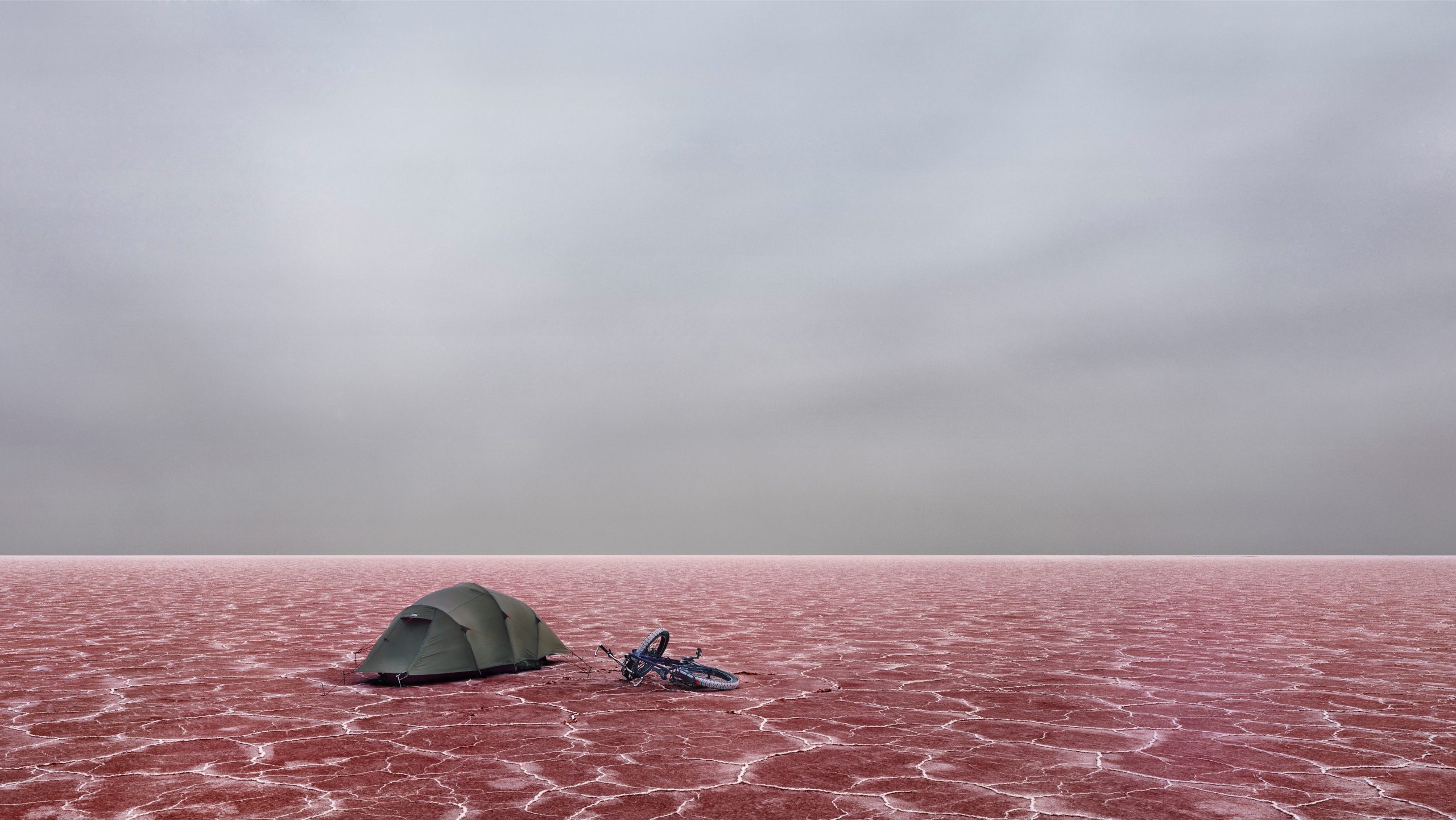
In 2003 Murray Fredericks first visited Kati Thanda–Lake Eyre, one of the world’s largest salt lakes, located in the deserts of Central Australia. Driven by the boundless potential of abstract space, Fredericks has returned 31 times over the past two decades, exploring perceptual states of being through photographs. His chapters, or ‘cycles’ as he calls them, have explored interventions with mirrors, and more recently fire, capturing infinity and the void through the lens of contemplative minimalism. Defined by light, colour and space, Fredericks’s photographs are a phenomenological response to the experience of existing in an ostensibly empty place without scale for extended periods of time.
Fredericks’s journeys across the salt plains of Kati Thanda–Lake Eyre have encompassed four distinct chapters: Salt, Vanity, Array and his most recent Blaze. Each chapter speaks of the power and potential of landscape, frequently utilising elements of weather, reflection, perspective, light and darkness to speak of the sensations that nature can produce in all of us.
Kati Thanda–Lake Eyre is an inland salt lake in South Australia’s desert region, where water travels thousands of kilometres through interconnected river systems before evaporating and leaving behind an immense salt landscape.
Salt, Fredericks’s first cycle, began in 2003. For the first few years and with access from farmers, Fredericks would camp on the edge of the lake. On those initial visits he brought the bare necessities. He would cycle out onto the lake to a point where there were no geographical features, set up camp and live for weeks at a time in what felt like a void.
In 2017 Fredericks exhibited the second ‘cycle’ entitled Vanity. The series introduced mirrors, bringing a flat and reflective geometric shape into the landscape. Mirrors have a long and deep history in art and literature, often used as symbols of spiritual depth. Placed at the centre of the frame, the visual illusion of the mirror creates a feeling of infinity and directs the viewer’s gaze back out into the landscape.
Array, the third ‘cycle’, was exhibited in 2019. Five mirrors were positioned, shifting the perspective and depth of the landscape. For Fredericks, taking these images often involved waiting for long periods until the temporal elements became just right.
Blaze, the fourth and most recent ‘cycle’, has fire as its central theme, as it burns and emerges from shallow silken water. The works relate to our evolutionary response to and associations with flame, climate change and the intervention of humans in climate cycles.
